
Household budget template for families – who spends what?
A free household budget template for families: an Excel file with a person column, twelve categories, a budget per category and a yearly overview, plus a printable family sheet with one column per person. Child costs are split into fixed, variable and pocket money. No login, no email, no bank connection.
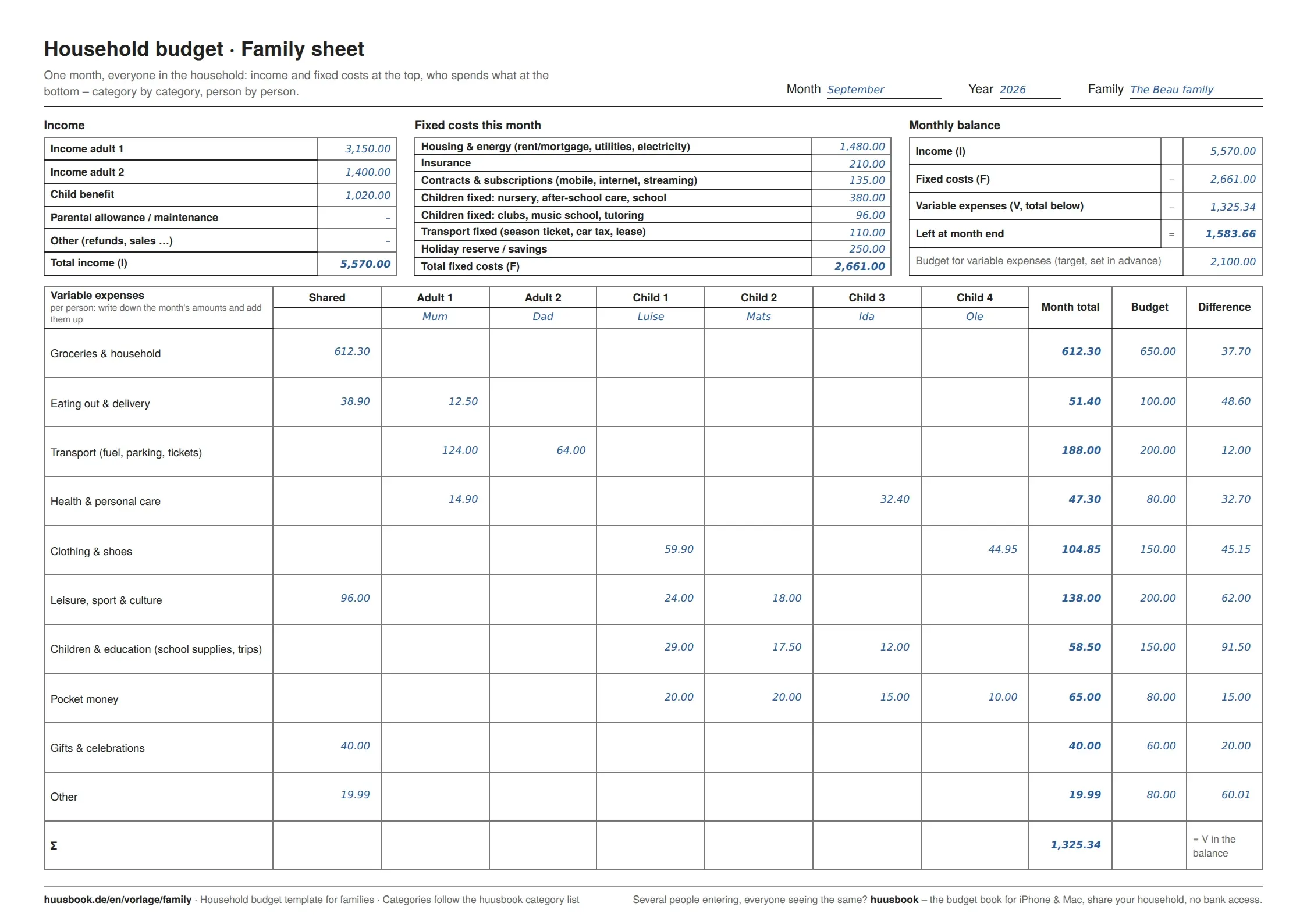
A budget book for one person is simple: one list, one total. From the second adult, and at the latest with children, a different question comes up – not just "what for", but "who". Who paid for the weekly shop, who for the shoes, who for the club fee, and which of it was shared? This template answers both. The Excel file gets a person column, the categories follow our category list, and child-related costs sit in three separate pots so that nobody argues about "just that little bit" at month end. If you prefer paper, take the family sheet: one A4 landscape page with a column per person.
Downloads
free · no email required · available right away
What the family template does differently from a normal budget book
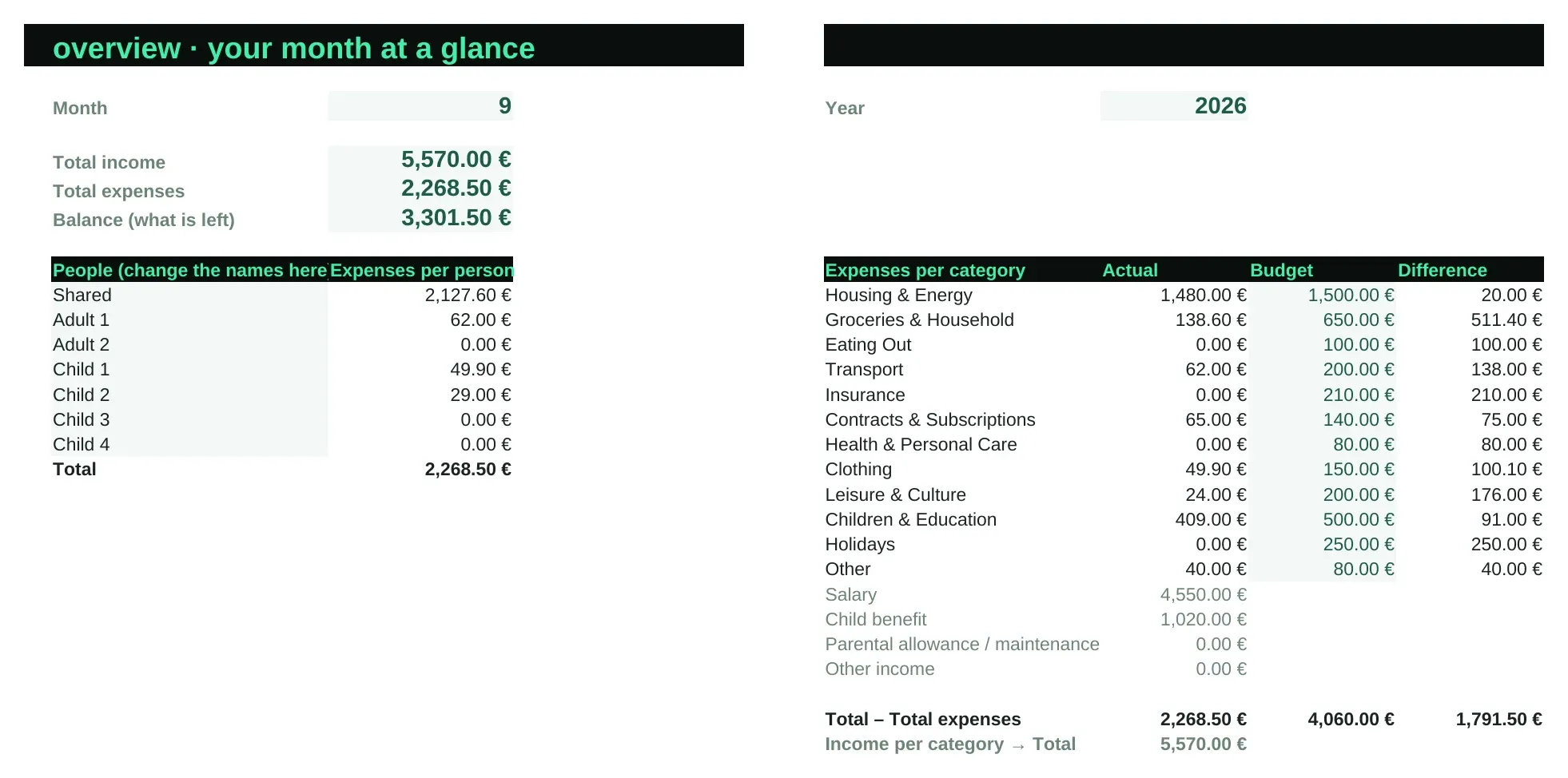
Three things: every entry gets a person (Shared, adults, up to four children), so the overview shows not only expenses per category but also per person. The categories include "Children & Education" with a fixed and a variable share as well as pocket money. And every category has a budget the overview checks the month against.
The person column is not a gimmick. The most common argument about money in families is not about the total but about responsibility – who pays for what, and is it fair? As soon as every row carries a person, the question is answered in seconds. The overview totals per person and per category for the chosen month; the "Year" sheet puts all twelve months side by side.
The categories are the same twelve as on the printable sheets: Housing & Energy, Groceries & Household, Eating Out, Transport, Insurance, Contracts & Subscriptions, Health & Personal Care, Clothing, Leisure & Culture, Children & Education, Holidays, Other. Plus four income categories: Salary, Child benefit, Parental allowance/maintenance, Other income.
Which file suits you?
The Excel file if you want totals per person and category at month end without doing the maths. The family sheet if the numbers should hang on the fridge and everyone in the household writes with a pen. Both together if the sheet collects during the day and one person transfers in the evening.
File | For whom | What it does | Effort |
|---|---|---|---|
Family household budget (Excel) | One adult types, everyone looks | Person column, month selector, budget per category, expenses per person, yearly overview | 5 minutes in the evening |
Family sheet (PDF, A4 landscape) | Everyone writes themselves, on the fridge | Income, fixed costs, balance, one column per person for variable expenses | 1 minute per receipt |
huusbook app (shared household) | Everyone enters on their own device | Every entry instantly with everyone, categories and budgets, no typing into spreadsheets | Seconds per entry |
The Excel file opens in Excel, Numbers and Google Sheets. The dropdowns for type, person and category work in all three; you change the people's names once on the "Overview" sheet, after that they appear in every menu.
How to set up the Excel template – in ten minutes
Open the "Overview" sheet, enter the names of your people and pick month and year. Then go to the "Transactions" sheet: one row per income or expense with date, type, person, category and amount. The overview calculates from the first row. Budgets go into the column next to it.
First step: the names. "Adult 1" becomes Mum, "Child 3" becomes Ida. The "Shared" field stays – that is where rent, the weekly shop and everything that cannot be attributed to one person belong. Second step: enter this month's fixed costs as the first rows so the balance is right from the start – rent, insurance, nursery fee, club fees. Third step: the budgets. In the overview, enter next to every category what may be spent this month. The "Difference" column then shows where it gets tight – not at month end, but on the day it happens.
An honest note: in the first week, usually only one person enters anything. That is fine. More important than completeness from day one is that the fixed costs and the weekly shop are in – housing and food alone make up half of all family spending according to the German EVS 2023 survey.
What a family spends per month
A four-person household in Germany spends 4,599 euros a month on private consumption according to the 2023 Income and Consumption Survey (EVS) of the Federal Statistical Office. The biggest items: housing & energy 1,582 euros, food 703 euros, transport 608 euros, leisure 412 euros, eating out 333 euros, clothing 205 euros, education 81 euros.
More interesting than the total is the comparison with a couple without children: food rises from 480 to 703 euros, clothing from 114 to 205 euros – children's feet grow – and spending on education increases fivefold from 16 to 81 euros. Exactly these three categories are the ones families need a budget for, because they creep. Housing, by contrast, is the largest item for families in absolute terms at 34.4 percent of spending, but lower in percentage terms than for singles (42.6 percent) – the rent is shared, the fridge is not.
Category (EVS 2023, Germany) | Couple (2 pers.) | Family (4 pers.) |
|---|---|---|
Total consumer spending | €3,382 | €4,599 |
Housing & energy | €1,240 (36.7%) | €1,582 (34.4%) |
Food & drink | €480 (14.2%) | €703 (15.3%) |
Transport | €405 (12.0%) | €608 (13.2%) |
Leisure, sport, culture | €301 (8.9%) | €412 (9.0%) |
Restaurants & accommodation | €246 (7.3%) | €333 (7.2%) |
Clothing & shoes | €114 (3.4%) | €205 (4.5%) |
Education services | €16 (0.5%) | €81 (1.8%) |
Source: Federal Statistical Office of Germany (Destatis), EVS 2023, consumer spending per household and month by household size, as of 9 December 2025. The figures are German and a yardstick, not a target: a family of six sits above them, and home ownership moves "housing" into the mortgage payment. What the numbers do is give you a feel for which category is out of line in your household.
Child-related costs: fixed, variable or pocket money?
Child-related costs belong in three pots. Fixed: nursery, after-school care, school meals, club and music school fees – once a month, changeable only with a notice period. Variable: clothing, school supplies, trips, birthday presents for classmates – ongoing, decided afresh every day. Pocket money: its own item, because once paid out it belongs to the child and no longer to your category.
In the Excel template, fixed child costs go under "Children & Education" with the person "Shared", variable ones under the same category with the respective child as the person – so at month end you see what the nursery costs and what Ida costs. On the family sheet, fixed child costs are pre-printed at the top in the fixed-costs block (nursery/after-school/school and clubs/music school separately), at the bottom in the matrix every child has their column, and pocket money is a row of its own. Children's birthdays as a guest, by the way, are the item almost every family underestimates: four children, five invitations a year each, 20 euros per gift – that is 400 euros that appear in no budget if "gifts" has no row of its own.
Who pays for what – joint account or separate pots?
The template does not prescribe a model. If you have a joint account, use "Shared" for almost everything and the persons only for personal expenses. If you keep separate accounts, attribute every expense to the person who paid it – the overview then shows who advanced how much during the month.
At our house it is a mix: one joint account for everything that concerns the household, and the person column mainly for the children. Not to control them, but to see when an item is out of line – shoes in two sizes in the same quarter, a school trip, a new bike. How we do it with four kids is written up in more detail.
When four people enter, one file is no longer enough
An Excel file lives on one computer. The family sheet hangs on the fridge. Both work as long as one person keeps the books. As soon as two adults pay on the go and both want to see where the month stands, the file becomes the bottleneck: who has the current version, who transfers the receipts? That is exactly what the shared household in huusbook is for – everyone enters on their own iPhone or Mac, everyone sees the same numbers, with the same categories and budgets as in this template. It is the only feature huusbook charges for (Pro, €1.49 a month or €9.99 a year); the app for one person is free. If you stick with the file, you still get everything here with no strings attached – no newsletter, no email address, no account. All templates at a glance are on the overview page.
Frequently asked questions
How many people is the family template made for?
For up to seven entries: Shared, two adults and four children. In the Excel file you change the names on the "Overview" sheet; if you have fewer people, simply leave the remaining rows as they are. On the family sheet, empty columns stay empty.
Can I change the categories in the family template?
Yes. The category list is on the "Overview" sheet (column "Expenses per category"). If you change a name there, the dropdown on the "Transactions" sheet picks it up automatically. New categories need a new row with the same total formula – copying is enough.
How do I enter child benefit and parental allowance?
As income with the category "Child benefit" or "Parental allowance / maintenance" and the person "Shared". That way they count in the balance but do not appear as a child's expense.
What is the difference between a budget book and a budget plan for families?
The budget book records what was spent; the budget plan sets in advance what may be spent. The family template does both: the transactions are the book, the "Budget" column per category is the plan, "Difference" shows the gap.
How much does a family of four spend per month?
According to the German EVS 2023 survey, on average 4,599 euros on private consumption, of which 1,582 euros on housing and energy and 703 euros on food. The figure is a German yardstick, not a target – location, home ownership and number of children shift it considerably.
Can my children enter things themselves?
On the family sheet, yes – every child has their column and writes with a pen. In the Excel file an adult should do the transferring. If the children have their own iPhone, it works in huusbook with a shared household: everyone enters themselves, everyone sees the same.
Is the family template really free and without sign-up?
Yes. The Excel file and the family sheet cost nothing, there is no email requirement, no registration and no advertising in the files. You may pass them on – including to schools, parent councils or advice centres.
Also worth a look
Printable household budget template – three PDF sheets (A4)
Here are three printable household budget templates as PDF – free, no email required: a monthly sheet in A4 landscape with a column per category and a row per day, a weekly sheet for the kitchen table, and a yearly overview with twelve monthly columns. All three share the same pre-printed categories, save ink and fit together.